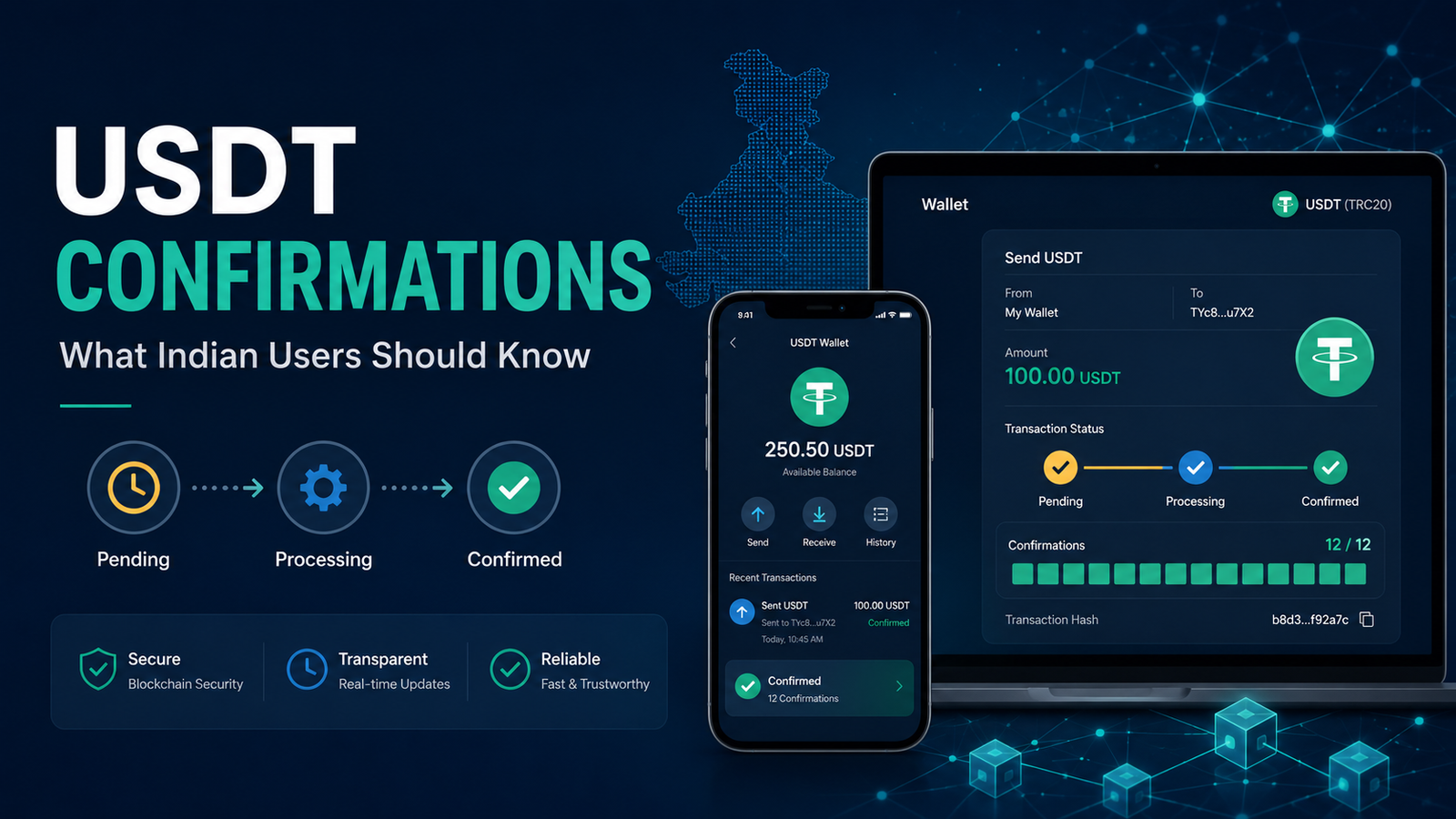
USDT Confirmations Explained: What Indian Users Should Know
USDT confirmations can be confusing when a transfer looks successful but the receiving wallet or exchange has not credited it yet.
You may send USDT, check the transaction and see that it has reached the blockchain. Still, the recipient may tell you that the balance has not appeared.
This does not always mean something went wrong.
A blockchain transaction and a platform deposit are not exactly the same thing. A transaction first needs to be processed by the blockchain, while an exchange or other platform may have its own process before showing the funds in a user’s account.
Understanding confirmations can make this situation easier to check.
What Does a USDT Confirmation Mean?
When you send USDT through a blockchain network, the transaction needs to be recorded by that network.
Once the transaction is included in a block, the blockchain has a record of it.
As the network continues processing new blocks, the transaction becomes more difficult to change or reverse.
This is the basic idea behind confirmations.
You do not need to understand all the technical details to use USDT safely.
For most users, the important questions are:
- Has the transaction reached the blockchain?
- Is it successful?
- Is the receiving address correct?
- Is the network correct?
- Has the receiving platform credited the deposit?
Confirmations help answer part of that process.
Confirmation Is Not the Same as Payment Received
This difference is very important.
Imagine that you send USDT to an exchange.
The blockchain may show that the transaction was successful.
But the exchange may still show:
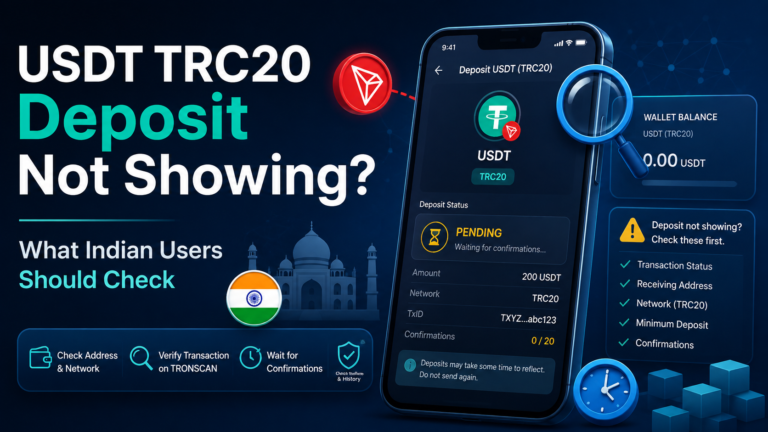
Deposit Pending
or the USDT balance may not appear yet.
That does not automatically mean the blockchain transaction failed.
The blockchain and the exchange’s internal system are two separate parts of the process.
The blockchain records the transfer.
The exchange then detects the deposit, checks the transaction and updates the user’s account according to its own process.
Because of this, a successful blockchain transaction may appear before the exchange balance changes.
USDT Can Use Different Blockchain Networks
USDT does not run on only one blockchain.
For example, users may send:
USDT TRC20 through the TRON network.
They may also send:
USDT ERC20 through Ethereum.
These networks work differently.
Their transaction processing and confirmation systems are also different.
This is one reason you should never assume that every USDT transfer will take exactly the same amount of time.
If you are unsure about the networks, read our USDT TRC20 vs ERC20 guide before sending another transaction.
The network you selected matters from the beginning of the transfer until the deposit is fully credited.
How Confirmations Work on TRON in Simple Terms
For a USDT TRC20 transaction, the transfer is processed by the TRON network.
The transaction is first accepted and included in a block.
The network then continues confirming the block until it reaches a more final state.
You do not need to count every technical step yourself.
For a normal user, the easiest approach is to check the transaction through a TRON blockchain explorer.
If you have the TxID, you can use TRONSCAN to see whether the transaction exists and what status it shows.
Our guide on how to check a USDT TRC20 transaction on TRONSCAN explains the process step by step.
What About ERC20 USDT?
ERC20 USDT uses Ethereum instead of TRON.
Ethereum also records transactions into blocks and then continues building new blocks after them.
Its confirmation and finality system is different from TRON.
This is another reason you should not compare a TRC20 transaction and an ERC20 transaction only by asking:
“Which one has more confirmations?”
The number shown by a wallet or platform does not always mean the same thing across different networks.
Always check the network first.
Why Do Exchanges Wait for Confirmations?
An exchange normally does not want to credit a deposit before it is confident that the blockchain transaction is valid and sufficiently settled.
This helps reduce the risk of crediting a transaction that has not reached an acceptable state on the network.
However, different platforms can use different deposit policies.
One exchange may credit a deposit sooner.
Another may wait longer.
The same platform may also use different requirements for different blockchain networks.
This is why there is no single confirmation number that you should assume applies to every USDT deposit.
If you send USDT to an exchange, check the deposit status shown by that exchange.
Do More Confirmations Mean the Transaction Is Safer?
In general, as a valid transaction becomes more settled on the blockchain, confidence in that transaction increases.
But for an everyday user, you usually do not need to sit and count blocks manually.
What matters is whether the transaction has reached the state required by the receiving service.
If you are sending USDT directly from one personal wallet to another, the receiving wallet may show the balance quickly.
If you are sending to an exchange, merchant or other platform, that service may wait before crediting the user’s internal balance.
The platform decides when it considers the deposit ready to credit.
Where Can You See the Confirmation Status?
The easiest place to start is your wallet or exchange transaction history.
Open the USDT transaction.
You may see information such as:
- Pending
- Processing
- Successful
- Confirmed
- Completed
The exact wording depends on the provider.
If the transaction has a blockchain transaction hash, you can also check it through the correct blockchain explorer.
For a TRON transaction, that can be TRONSCAN.
The USDT transaction hash (TxID) identifies the specific blockchain transaction you want to check.
Do not confuse the TxID with the receiving wallet address.
What If There Is No TxID Yet?
Suppose you request a USDT withdrawal from an exchange.
The exchange shows:
Processing
but no TxID is available.
In this situation, the withdrawal may still be inside the exchange’s own processing system.
It may not yet have been broadcast to the blockchain.
Without an on-chain transaction, there may be nothing for a blockchain explorer to find yet.
Do not immediately create another withdrawal.
First check whether the original withdrawal is still processing.
Sending again too quickly can create a duplicate payment if the first withdrawal later goes through.
What If the Transaction Is on the Blockchain but Still Waiting?
If the transaction already appears on the correct blockchain explorer, check its current status.
A transaction may appear before it reaches its more final confirmed state.
Give the blockchain time to process it.
Avoid repeatedly sending the same amount just because the recipient has not seen it yet.
If you are dealing with a delayed payment, our USDT transfer pending guide explains the other checks you should make before trying again.
What If TRONSCAN Shows the Transaction as Successful?
This is where many users become confused.
Suppose TRONSCAN shows:
- the transaction is successful,
- the USDT amount is correct,
- and the receiving address is correct.
But the exchange balance is still empty.
At this point, do not immediately assume that USDT disappeared.
Check the receiving platform’s deposit history.
It may show:
- Processing
- Pending
- Waiting for confirmation
- Under review
The exact wording can vary.
If the blockchain side looks correct, the next step may be checking the receiving platform rather than sending another transaction.
Check the Receiving Address Too
Confirmations do not tell you whether you chose the correct address.
A blockchain can successfully confirm a transaction sent to the wrong destination.
That transaction can still be a serious problem.
So when checking a USDT transfer, do not look only at the status.
Also check:
- destination address,
- network,
- amount,
- token.
A successful transaction only tells you that the network processed what was submitted.
It does not know what you originally intended to do.
Check the Network Before Waiting for Confirmations
Suppose an exchange gives you a TRC20 deposit address.
But you accidentally send the USDT using another network.
Waiting for more confirmations will not correct the network mistake.
Before thinking about confirmations, make sure that:
- the sending network matches the deposit network,
- the destination supports that network,
- and you used the correct address.
Network selection is one of the most important parts of a USDT transfer.
Can You Speed Up USDT Confirmations?
Be careful with this question.
If a transaction has already been submitted, what you can or cannot do depends on the blockchain, wallet and transaction state.
There is no universal button that safely “speeds up USDT” on every network.
Avoid random websites or people who promise:
Instant confirmation
USDT unlock
Blockchain acceleration
or:
Guaranteed recovery
Especially avoid anyone asking for:
- seed phrase,
- private key,
- wallet password,
- OTP,
- remote access to your phone.
Checking or waiting for blockchain confirmations should not require giving away control of your wallet.
A Confirmation Cannot Fix the Wrong Address
This is another misunderstanding worth avoiding.
More confirmations do not fix a mistake.
If you sent USDT to the wrong address, the blockchain may continue confirming exactly that transaction.
The same applies to choosing the wrong network.
Confirmations show how the blockchain is processing the transaction.
They do not change where you sent the funds.
That is why checking the network and address before sending remains important.
Screenshots Do Not Show the Whole Story
Someone may send you a screenshot saying:
Transaction Completed
But a screenshot alone may not tell you:
- which network was used,
- which address received the funds,
- whether the transaction is on-chain,
- or whether the screenshot belongs to the payment you are checking.
If a blockchain transaction exists, the TxID gives you a better way to identify the exact transfer.
For TRC20 USDT, you can check the TxID through TRONSCAN and compare the transaction information with the payment you expected.
When Should You Contact the Sending Exchange?
Consider checking with the sending exchange if:
- the withdrawal remains processing for a long time,
- no TxID has been created,
- the withdrawal shows an unexplained error,
- or the status is unclear.
Use the exchange’s official support channel.
Do not search for random support numbers or message accounts that contact you first.
When asking about the transaction, you may need details such as the withdrawal time, amount and transaction information.
Never give support your seed phrase or private key.
When Should You Contact the Receiving Platform?
The receiving side becomes more relevant when:
- the blockchain transaction is successful,
- the receiving address is correct,
- the network is correct,
- but the deposit still does not appear.
Keep the TxID available.
This gives the platform a specific blockchain transaction to investigate.
Do not send another payment simply because the first one has not appeared in the internal balance yet.
Do Confirmations Always Take the Same Time?
No.
The time can depend on:
- blockchain network,
- transaction state,
- network conditions,
- wallet or exchange processing,
- and the receiving platform’s deposit policy.
This is why statements such as:
“Every USDT transfer takes exactly five minutes”
should be treated carefully.
Even two transfers using USDT can behave differently when they use different networks or services.
Instead of relying on one fixed time, check the actual transaction.
What Should You Check While Waiting?
If a USDT deposit has not appeared yet, check these points one by one:
- Was the withdrawal actually sent?
- Is there a TxID?
- Which network was used?
- Can you find the transaction on the correct explorer?
- Does the transaction show a successful status?
- Is the destination address correct?
- Is the USDT amount correct?
- Does the receiving platform support that network?
- What does the receiving platform’s deposit history show?
This usually gives you much more useful information than simply waiting and wondering whether the money disappeared.
A Simple Way to Think About USDT Confirmations
You do not need to become a blockchain expert.
Think of a USDT transfer as moving through a few stages:
You send the transaction.
↓
The blockchain receives and records it.
↓
The transaction becomes more settled or confirmed on the network.
↓
The receiving wallet or platform detects it.
↓
If it is a platform, the platform credits the user’s balance.
Those stages do not always happen at exactly the same moment.
That is why a transaction can look successful on the blockchain while the receiving platform still says the deposit is pending.
When that happens, check the TxID, network, address and deposit status before doing anything else.
Sending the same USDT again should not be your first response.