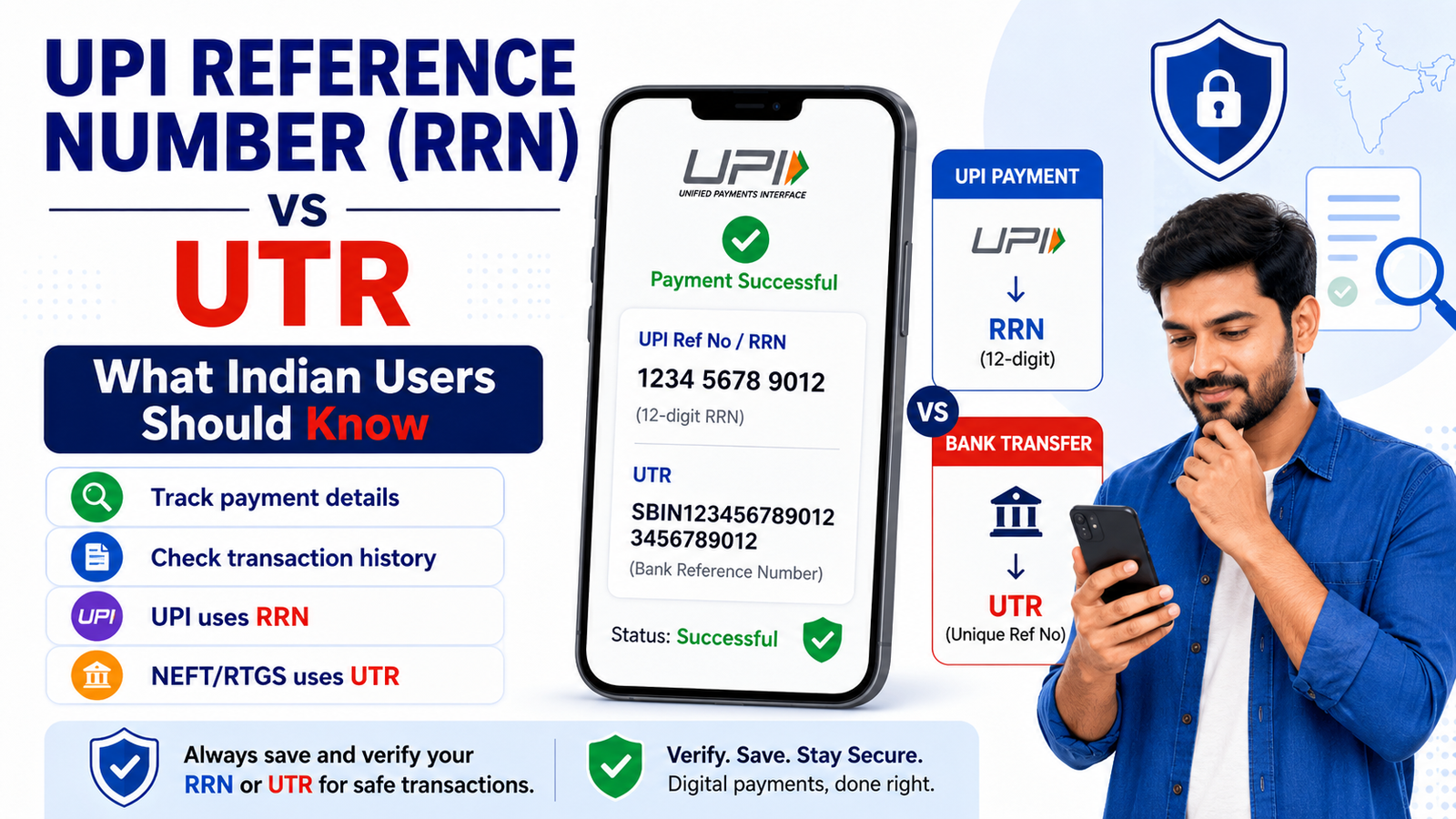
UPI Reference Number (RRN) vs UTR: What Indian Users Should Know
When a digital payment has a problem, you may be asked for a UPI reference number, transaction ID, RRN, or UTR number.
These terms can sound similar, especially when you are trying to find a payment quickly.
However, they do not always mean exactly the same thing.
For UPI payments, you may see a UPI Reference Number, often called an RRN. For bank transfers such as NEFT or RTGS, you may instead see a UTR number.
Knowing which reference number belongs to your transaction can make it easier to check a payment, contact your bank, or report a failed or disputed transaction.
What Is a UPI Reference Number?
A UPI reference number is a unique number connected to a specific UPI transaction.
It helps banks and payment systems identify the payment when you need to check what happened.
In many UPI apps, this may be shown as:
- UPI Ref No;
- RRN;
- UPI Reference Number;
- transaction reference.
The exact label may depend on the payment app you are using.
HDFC Bank describes the UPI Retrieval Reference Number, or RRN, as a unique 12-digit identifier for a UPI transaction. Paytm also describes its UPI Ref No as a 12-digit RRN used to identify and track a UPI payment.
What Does RRN Mean?
RRN stands for Retrieval Reference Number.
You normally do not need to memorise this number.
It is generated as part of the transaction process and can usually be found later in the transaction details inside your payment app.
The main purpose is simple:
It helps identify one particular payment among many transactions.
This becomes especially useful if:
- money was debited but the receiver says it did not arrive;
- a transaction is pending;
- a payment failed;
- you are checking a refund;
- you need to contact your bank or payment provider;
- you are trying to identify a specific payment from your history.
HDFC Bank specifically notes that the RRN can help with transaction tracking and dispute handling when a UPI payment has a problem.
Where Can You Find Your UPI Reference Number?
The exact steps depend on your UPI app, but the general process is usually similar.
Open your payment app and go to your transaction history.
Select the payment you want to check.
Then open the full transaction details.
Look for a field such as:
UPI Ref No
RRN
Reference Number
or another similar transaction reference.
For example, Paytm says users can open Balance & History, select the transaction, open its details, and look for UPI Ref No.
Different apps may arrange their menus differently, so do not worry if your screen does not look exactly the same.
The important thing is to open the individual transaction and view its detailed information.
Is a UPI Reference Number the Same as a Transaction ID?
Not necessarily.
A payment app may display several identifiers for one transaction.
For example, you may see:
- UPI reference number or RRN;
- transaction ID;
- app-specific order ID;
- merchant reference;
- bank reference.
These identifiers may be used for different parts of the payment process.
If customer support asks you for a specific number, check exactly which one they need.
Do not simply send every number or screenshot you have.
Providing the correct transaction reference can make it easier for the bank or payment provider to locate the payment.
Paytm’s current support guidance also notes that if an RRN cannot be used for tracking in a particular case, a transaction ID may sometimes be requested instead.
What Is a UTR Number?
UTR stands for Unique Transaction Reference.
It is commonly associated with bank transfer systems such as NEFT and RTGS.
For RTGS, the Reserve Bank of India states that the UTR is a 22-character code used to uniquely identify an RTGS transaction.
For NEFT transactions, RBI also says customers may need to provide a UTR number or transaction reference number when asking their bank to track a transfer.
So although both UTR and UPI RRN help identify payments, you should not automatically assume they are the same type of reference number.
UPI Reference Number vs UTR: What Is the Difference?
The easiest way to remember the difference is:
UPI payment → usually look for UPI Ref No / RRN
NEFT or RTGS bank transfer → look for UTR / transaction reference
The format may also be different.
UPI RRN is commonly shown as a 12-digit number by UPI providers such as HDFC Bank and Paytm.
RBI states that an RTGS UTR contains 22 characters.
However, apps and banks may use slightly different labels on their screens.
That is why the safest approach is to check the payment method first before deciding which number you need.
Why Is the Reference Number Important?
Imagine you send ₹3,000 through UPI.
Your bank account is debited.
Your UPI app shows the transaction.
But the receiver says:
“I have not received the money.”
Simply saying “I paid ₹3,000” may not be enough to identify the exact transaction.
The reference number gives the bank or payment provider a more precise way to locate that payment.
The same idea applies to bank transfers.
RBI says NEFT customers who want faster transaction tracking may need to provide information such as the UTR or transaction reference number, transaction date, amount, sender details, and beneficiary information.
What Details Should You Save After a Payment?
You do not need to take screenshots of every small transaction.
But when a payment is important, disputed, or showing an unusual status, keep the useful transaction details.
These may include:
- UPI reference number or RRN;
- transaction ID;
- amount;
- receiver name;
- receiver UPI ID;
- date and time;
- payment status;
- bank account used;
- screenshot of the transaction details.
These details can make it easier to explain the problem accurately when contacting support.
For bank transfers, keep the UTR or bank transaction reference as well.
What If Money Is Debited but the Receiver Has Not Received It?
First, check the transaction status inside your UPI app.
Do not immediately send the payment again.
If the first transaction is only delayed, sending again could result in two payments.
Open the transaction details and save the reference number.
Then check whether the transaction is:
Successful
Pending
or
Failed
If the problem continues, use the official support option inside your payment app or contact your bank.
Our guide about UPI payments that fail or remain pending explains what to check in this situation.
Can a Reference Number Prove That Someone Received the Money?
A reference number identifies a transaction, but you should still check the actual transaction status.
Someone may send you a screenshot containing a reference number and claim:
“Payment successful.”
Do not trust the screenshot alone.
Check your own bank account or payment app.
If you are a seller, verify whether the money has actually been credited.
A transaction reference can help identify a payment, but it should not replace checking your own account.
This is especially important when dealing with strangers or unfamiliar buyers.
Be Careful With Fake Payment Screenshots
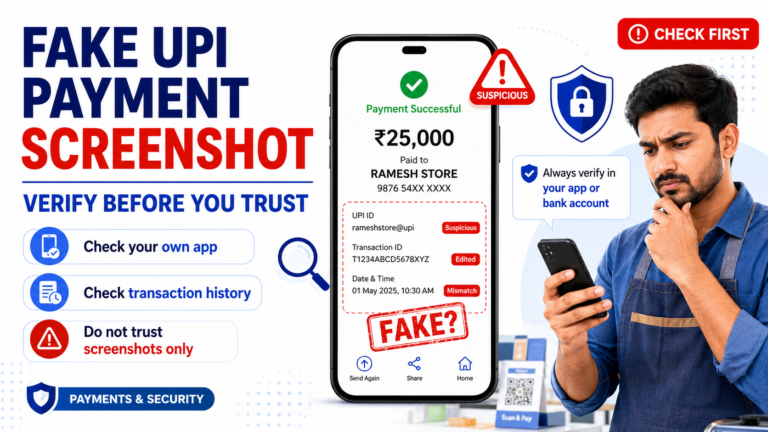
Fraudsters may sometimes show edited screenshots that look like genuine UPI confirmations.
They may include:
- a fake reference number;
- fake transaction ID;
- fake receiver name;
- fake amount;
- fake successful status.
Do not release goods, services, or refunds simply because someone shows you a screenshot.
Check the payment through your own official bank or UPI app.
This topic will also be useful for one of our next guides because fake payment screenshots deserve a full safety article of their own.
Should You Share Your UPI Reference Number?
A transaction reference number is not the same as your UPI PIN, OTP, CVV, or banking password.
It may be necessary to provide a reference number to your bank or official payment support when reporting a transaction issue.
However, you should still avoid posting complete transaction details publicly.
A screenshot may contain more information than you realise.
Before sharing transaction information, check whether it exposes:
- your mobile number;
- bank account details;
- UPI ID;
- receiver information;
- transaction history;
- other personal information.
Never share your UPI PIN or OTP while reporting a payment problem.
What If You Cannot Find the Reference Number?
Do not guess.
Open the transaction again and look for additional details.
If you still cannot find the number, contact the official support channel of your bank or payment app.
Tell them:
- the transaction date;
- approximate time;
- amount;
- receiver;
- payment method.
They may be able to identify the transaction using other details.
Paytm, for example, notes that a transaction ID may also be useful where the RRN is not available for a particular support process.
What If You Sent Money to the Wrong Person?
A reference number can help identify the exact payment when you contact your bank or UPI provider.
Save it together with the other transaction details.
Do not delete the transaction history or conversation connected to the payment.
Our guide about UPI payments sent to the wrong person explains the next steps in more detail.
And before making another payment, read our guide on how to verify a UPI ID before sending money.
Simple Reference Number Checklist
When you have a payment problem, ask yourself:
- Was the payment made through UPI, NEFT, RTGS, or another method?
- What status does the transaction show?
- Can I find a UPI Ref No or RRN?
- Is there also a transaction ID?
- If it was a bank transfer, can I find the UTR?
- Did I save the amount, date, and receiver details?
- Am I checking the information inside the official app?
- Am I contacting the bank through an official support channel?
- Have I avoided sharing my UPI PIN or OTP?
- Have I kept the transaction details until the issue is resolved?
These simple checks can make payment problems easier to explain and investigate.
What to Remember
A UPI reference number helps identify a UPI payment.
It may appear as an RRN or UPI Ref No inside your payment app.
A UTR number is more commonly associated with bank transfer systems such as NEFT and RTGS. RBI specifically defines the RTGS UTR as a 22-character identifier and recommends keeping transaction reference information available when tracking NEFT transfers.
Do not worry about memorising every banking abbreviation.
The important thing is to know where to find the reference information when a payment has a problem.
Always check the transaction inside your own official banking or payment app, keep important transaction details, and never share your UPI PIN or OTP with anyone.
For more payment-safety basics, read our guide to safe digital payment methods for Indian users.
Rupzio Guide provides simple educational information to help Indian users understand digital payments and make safer online decisions.