UPI PIN vs OTP: What Indian Users Should Never Share
UPI PIN vs OTP can be confusing because both are security codes connected to digital payments and banking.
However, they are not the same thing.
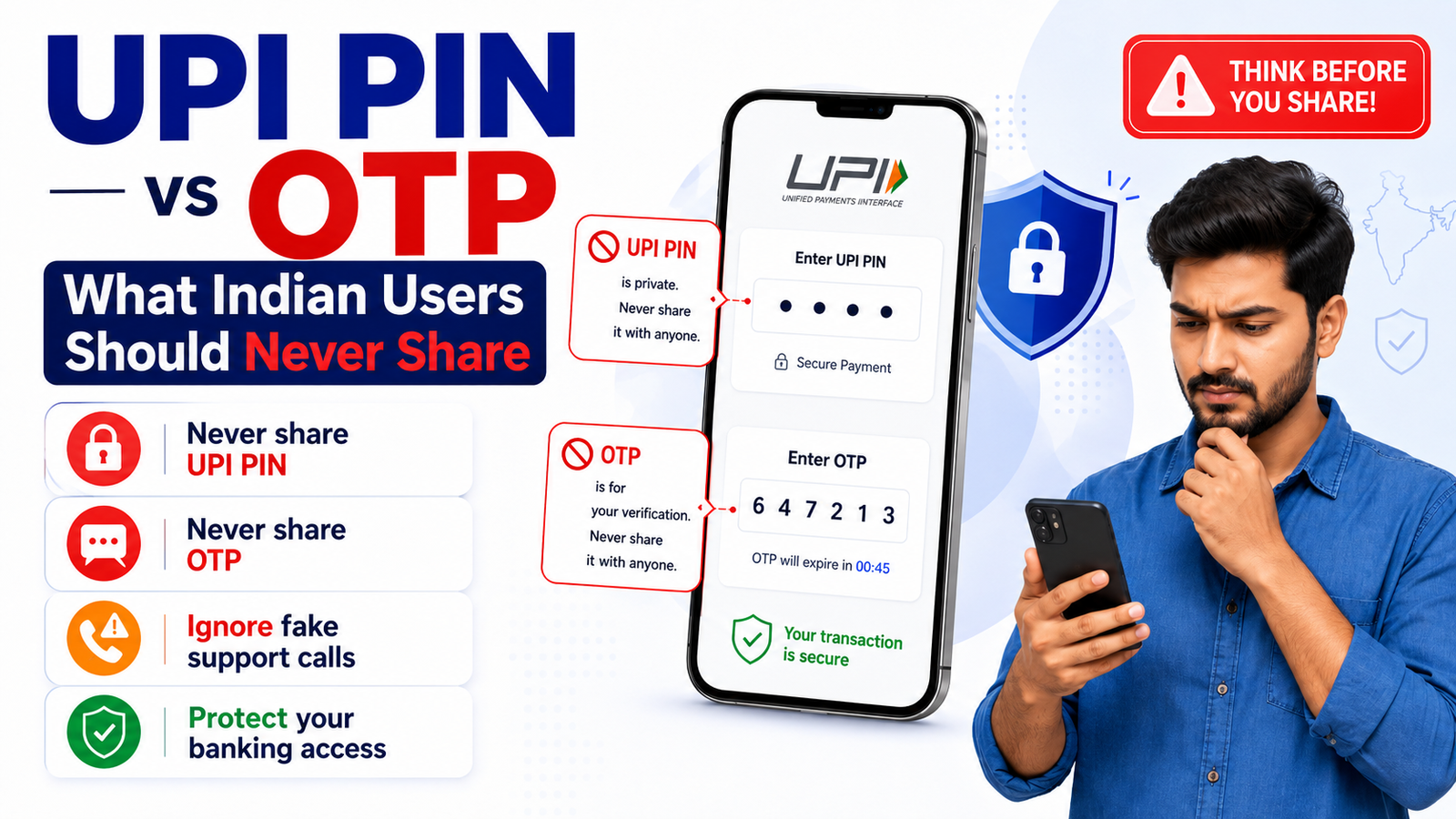
A UPI PIN is normally used to approve a UPI payment from your bank account, while an OTP may be used to verify your identity during certain banking, login, registration, or transaction processes.
The most important rule is simple:
Do not share your UPI PIN or OTP with another person.
Understanding what these codes do can help you recognise suspicious calls, messages, payment requests, and fake customer-support scams.
What Is a UPI PIN?
A UPI PIN is a confidential number used to authorise UPI transactions from your bank account.
You create or set your UPI PIN when linking an eligible bank account to a UPI app.
Depending on the bank and app, the PIN commonly contains four or six digits.
When you make a normal UPI payment, your app may ask you to enter this PIN before the money is sent.
Think of your UPI PIN as an approval key.
Entering it means you are authorising a transaction through your UPI account.
That is why you should enter it only inside the official UPI PIN screen of your payment app.
What Is an OTP?
OTP stands for One-Time Password.
It is a temporary security code that may be sent to your registered mobile number or generated during a banking or verification process.
Unlike a permanent password, an OTP is generally intended for one specific verification or transaction and expires after a short period or after use.
You may see an OTP when:
- registering or verifying a banking service;
- resetting certain account details;
- confirming some online transactions;
- activating a service;
- verifying your identity;
- completing certain security checks.
Even though an OTP is temporary, it is still confidential.
Do not assume it is safe to share simply because it will expire later.
UPI PIN vs OTP: What Is the Difference?
The easiest way to understand the difference is to look at their purpose.
A UPI PIN is connected to authorising UPI transactions from your account.
An OTP is a temporary verification code that may be used for different banking or security processes.
Both protect access to important financial actions.
Both should remain private.
And neither should be given to a stranger, caller, merchant, social-media contact, or someone claiming they need the code to help you.
If another person asks you to read out a UPI PIN or OTP, stop and check what is actually happening.
You Do Not Need to Share a UPI PIN to Receive Money
This is one of the most important UPI safety rules.
If someone wants to send money to you, you do not need to tell them your UPI PIN.
You also should not enter your UPI PIN simply because someone says:
“Enter your PIN to receive ₹5,000.”
That should immediately make you cautious.
Entering a UPI PIN on a payment approval screen normally means you are authorising money to leave your account.
If you receive an unexpected collect request, check it carefully before doing anything.
Our guide on how to check a UPI payment request before you approve it explains this situation in more detail.
Never Tell Your UPI PIN to Customer Support
A common scam starts with someone claiming to work for:
- your bank;
- a UPI app;
- a wallet company;
- an online marketplace;
- a delivery company;
- a government department;
- a merchant.
They may sound professional.
They may even know your name, phone number, bank name, or details about a recent transaction.
Then they ask for your UPI PIN.
Do not provide it.
Knowing some information about you does not prove that the caller is genuine.
If you have a payment problem, end the suspicious conversation and contact the bank or payment app using its official website or app.
Do not trust a customer-care number sent by the caller.
Never Share an OTP Over a Phone Call
The same rule applies to OTPs.
A fraudster may call and say:
“We have sent an OTP to verify your account.”
They may then ask you to read the number aloud.
Do not do it.
An OTP can be part of a security process happening in the background.
If you did not start that process yourself, receiving an unexpected OTP can be a warning sign that someone may be trying to access or change something connected to your account.
Do not approve or share information simply because the caller sounds urgent.
Be Careful With Messages Asking for an OTP
Fraud attempts do not always happen through phone calls.
You may receive messages through:
- SMS;
- WhatsApp;
- Telegram;
- email;
- social media;
- fake support chats.
A message may claim:
“Your KYC will expire today.”
“Your bank account will be blocked.”
“Your refund is waiting.”
“Verify your account immediately.”
“Send the OTP to complete your cashback.”
These messages often create urgency because rushed users are less likely to check carefully.
Do not send an OTP back through chat or message.
Instead, open the official banking or payment app independently and check whether there is actually a problem.
UPI PIN Is Not the Same as Your ATM PIN
Another common source of confusion is the number of PINs and passwords people use.
Your UPI PIN, ATM/debit card PIN, mobile banking PIN, and internet banking password may protect different services.
Do not assume they are interchangeable.
More importantly, do not reuse sensitive codes unnecessarily.
And never send these confidential details through WhatsApp, SMS, email, or social media.
A legitimate payment does not require you to send a screenshot containing your PIN or password.
What Information Can You Normally Share?
People sometimes become so worried about scams that they are unsure whether they can share any payment information at all.
Some information may be needed for legitimate payments.
For example, someone sending you money may need your UPI ID.
Your UPI ID is not the same as your UPI PIN.
For example:
rahul@upi
may be a payment address.
But your private UPI PIN should never be written beside it or sent to another person.
Similarly, someone may need your account details for a legitimate bank transfer, but that does not mean they need your OTP, PIN, CVV, or banking password.
Always separate payment details used to identify where money should go from security credentials used to authorise or protect your account.
Be Careful With Screen Sharing
Some fraudsters may not directly ask:
“What is your UPI PIN?”
Instead, they may ask you to install a screen-sharing or remote-access app.
They may say they need to see your screen to solve a payment problem.
This can expose sensitive information while you use your banking or payment app.
Be especially careful if someone you do not know asks you to:
- share your phone screen;
- install remote-control software;
- open your banking app while they watch;
- show an OTP notification;
- enter a UPI PIN while screen sharing.
Do not allow an unknown person to watch or control sensitive financial activity on your phone.
What If Someone Already Knows Your UPI ID?
Do not panic.
A UPI ID and UPI PIN are different.
Knowing your UPI ID does not automatically give someone permission to approve payments from your account.
However, a fraudster who knows your UPI ID may send suspicious payment requests or try to trick you into authorising something.
That is why you should still check:
- requester name;
- amount;
- payment purpose;
- UPI ID;
- warning messages inside the app.
Our guide on how to verify a UPI ID before sending money explains additional checks you can make before completing a payment.
What If You Accidentally Shared Your UPI PIN or OTP?
Act quickly.
Do not continue talking to the person who requested the information.
Open your official bank or payment app and check your recent transactions.
If available, change or reset the affected PIN or password using the official app or banking channel.
Contact your bank immediately if you notice an unauthorised transaction or believe your account security may have been compromised.
Keep evidence such as:
- suspicious phone numbers;
- SMS messages;
- WhatsApp conversations;
- screenshots;
- transaction IDs;
- dates and times;
- amounts;
- receiver information.
Do not pay another person who promises they can recover the money for a fee.
Fraud victims can sometimes be targeted again by people pretending to offer recovery services.
What If You Receive an OTP You Did Not Request?
Do not share it.
Do not click a link in the same suspicious message.
An unexpected OTP does not always mean money has already been stolen, but it deserves attention.
Check your banking or payment account through the official app.
Look for unusual login attempts, transactions, account changes, or notifications.
If something looks suspicious, contact your bank using an official support channel.
Never call a random “customer care” number found in an unknown message or advertisement.
Simple UPI PIN and OTP Safety Checklist
Before entering or sharing any security code, ask yourself:
- Did I start this transaction myself?
- Am I inside the official banking or UPI app?
- Do I understand what I am approving?
- Am I being asked to share an OTP with another person?
- Is anyone asking me to reveal my UPI PIN?
- Am I being told I need a PIN to receive money?
- Is someone creating unnecessary urgency?
- Did I receive an unexpected payment request?
- Is someone asking me to share my screen?
- Have I checked the receiver and amount before approving anything?
If something does not make sense, stop.
You do not need to complete a financial transaction simply because another person is waiting or pressuring you.
Common Rule to Remember
When comparing UPI PIN vs OTP, remember that both are security credentials.
Their exact purpose is different, but your safety rule should be the same:
Keep them private.
Do not send them through messages.
Do not read them aloud to callers.
Do not type them into unfamiliar websites.
Do not share screenshots that expose them.
And do not allow another person to pressure you into using them for a transaction you do not understand.
Before entering your UPI PIN, check the receiver, amount, and reason for payment.
If a payment request looks suspicious, our UPI scam warning for Indian users covers common tricks you should know.
You can also read our guide to safe digital payment methods for Indian users for more basic payment-safety practices.
Rupzio Guide provides simple educational information to help Indian users understand digital payments and make safer online decisions.